
















• Contact
Crypto Experts
Advertisement
  • Bitcoin
    Bitcoin's Recent Dip Triggers Massive Market Liquidations

    Bitcoin’s Recent Dip Triggers Massive Market Liquidations

    U.S. Government Authorized to Sell $6.5 Billion in Seized Bitcoin

    U.S. Government Authorized to Sell $6.5 Billion in Seized Bitcoin

    Robert Kiyosaki Claims That BlackRock Is Manipulating Bitcoin Price

    Robert Kiyosaki Claims That BlackRock Is Manipulating Bitcoin Price

    Bitcoin Breaks the $100,000 Barrier

    Bitcoin Breaks the $100,000 Barrier

  • Market
    How Previous Inauguration Events Affected The Crypto Market

    How Previous Inauguration Events Affected The Crypto Market

  • News
    Ethereum Price Stabilizes

    Ethereum Price Stabilizes After the $4,900 Drop: What It Means for the Crypto Market

    Trump's New Meme Coin Surges in Value Ahead of Inauguration

    Trump’s New Meme Coin Surges in Value Ahead of Inauguration

    XRP and Solana Prices Soar Amid Reserve Rumors

    XRP and Solana Prices Soar Amid Reserve Rumors

    Sygnum Bank Joins the Billion-Dollar Club with $58M Funding Round

    Sygnum Bank Joins the Billion-Dollar Club with $58M Funding Round

  • Airdrops
    Bio-protoco-Decentralized-Science-(DESCI)

    Bio Protocol Is The New Airdrop On Binance Launchpool

    Vana - The New Project on Binance Launchpool

    Vana – The New Project on Binance Launchpool

  • Crypto-Pedia
    What Is Accumulation in Financial Markets

    What Is Accumulation in Financial Markets?

    What Is Absorption in Crypto Markets and Why It Matters

    What Is Absorption in Crypto Markets and Why It Matters

    What Is Ethereum And How It Works

    What Is Ethereum And How It Works

    What Is A Stablecoin - Types Of Stablecoins And How They Work

    What Is A Stablecoin? Types Of Stablecoins And How They Work

  • Converter
No Result
View All Result
  • Bitcoin
    Bitcoin's Recent Dip Triggers Massive Market Liquidations

    Bitcoin’s Recent Dip Triggers Massive Market Liquidations

    U.S. Government Authorized to Sell $6.5 Billion in Seized Bitcoin

    U.S. Government Authorized to Sell $6.5 Billion in Seized Bitcoin

    Robert Kiyosaki Claims That BlackRock Is Manipulating Bitcoin Price

    Robert Kiyosaki Claims That BlackRock Is Manipulating Bitcoin Price

    Bitcoin Breaks the $100,000 Barrier

    Bitcoin Breaks the $100,000 Barrier

  • Market
    How Previous Inauguration Events Affected The Crypto Market

    How Previous Inauguration Events Affected The Crypto Market

  • News
    Ethereum Price Stabilizes

    Ethereum Price Stabilizes After the $4,900 Drop: What It Means for the Crypto Market

    Trump's New Meme Coin Surges in Value Ahead of Inauguration

    Trump’s New Meme Coin Surges in Value Ahead of Inauguration

    XRP and Solana Prices Soar Amid Reserve Rumors

    XRP and Solana Prices Soar Amid Reserve Rumors

    Sygnum Bank Joins the Billion-Dollar Club with $58M Funding Round

    Sygnum Bank Joins the Billion-Dollar Club with $58M Funding Round

  • Airdrops
    Bio-protoco-Decentralized-Science-(DESCI)

    Bio Protocol Is The New Airdrop On Binance Launchpool

    Vana - The New Project on Binance Launchpool

    Vana – The New Project on Binance Launchpool

  • Crypto-Pedia
    What Is Accumulation in Financial Markets

    What Is Accumulation in Financial Markets?

    What Is Absorption in Crypto Markets and Why It Matters

    What Is Absorption in Crypto Markets and Why It Matters

    What Is Ethereum And How It Works

    What Is Ethereum And How It Works

    What Is A Stablecoin - Types Of Stablecoins And How They Work

    What Is A Stablecoin? Types Of Stablecoins And How They Work

  • Converter
No Result
View All Result
Crypto Experts
No Result
View All Result
Home Crypto-Pedia

What Is Accumulation in Financial Markets?

George Evan by George Evan
January 24, 2026
in Crypto-Pedia
Reading Time: 4 mins read
0
What Is Accumulation in Financial Markets

What Is Accumulation in Financial Markets

33
SHARES
476
VIEWS
Share on FBShare on X

Accumulation is one of the most important — and often misunderstood — phases in financial markets. It refers to a period when large, informed participants gradually build positions at relatively low prices, usually after a significant market decline. Unlike sharp price rallies or sell-offs, accumulation is quiet, slow, and often goes unnoticed by most traders.

Understanding accumulation helps explain why major market moves rarely start from excitement or strong bullish sentiment. Instead, they begin when interest is low, volatility is muted, and prices appear to go nowhere.

What Accumulation Really Means

In simple terms, accumulation means gradual buying over time. Large buyers, such as institutions or long-term investors, do not buy all at once. Doing so would push prices higher and increase their average entry cost. Instead, they spread their purchases across days, weeks, or even months.

During accumulation:

  • Selling pressure exists but weakens over time

  • Buyers consistently absorb supply

  • Price remains within a relatively narrow range

The goal is not immediate price appreciation, but to build exposure efficiently and quietly.

When Accumulation Usually Occurs

Accumulation typically follows a clear downtrend. This context is critical. Markets don’t accumulate at random points.

Common conditions include:

  • A prolonged price decline
  • Negative sentiment and poor headlines
  • Reduced trading activity
  • Lack of public interest

Retail participants often lose confidence during this phase, while stronger hands become more active.
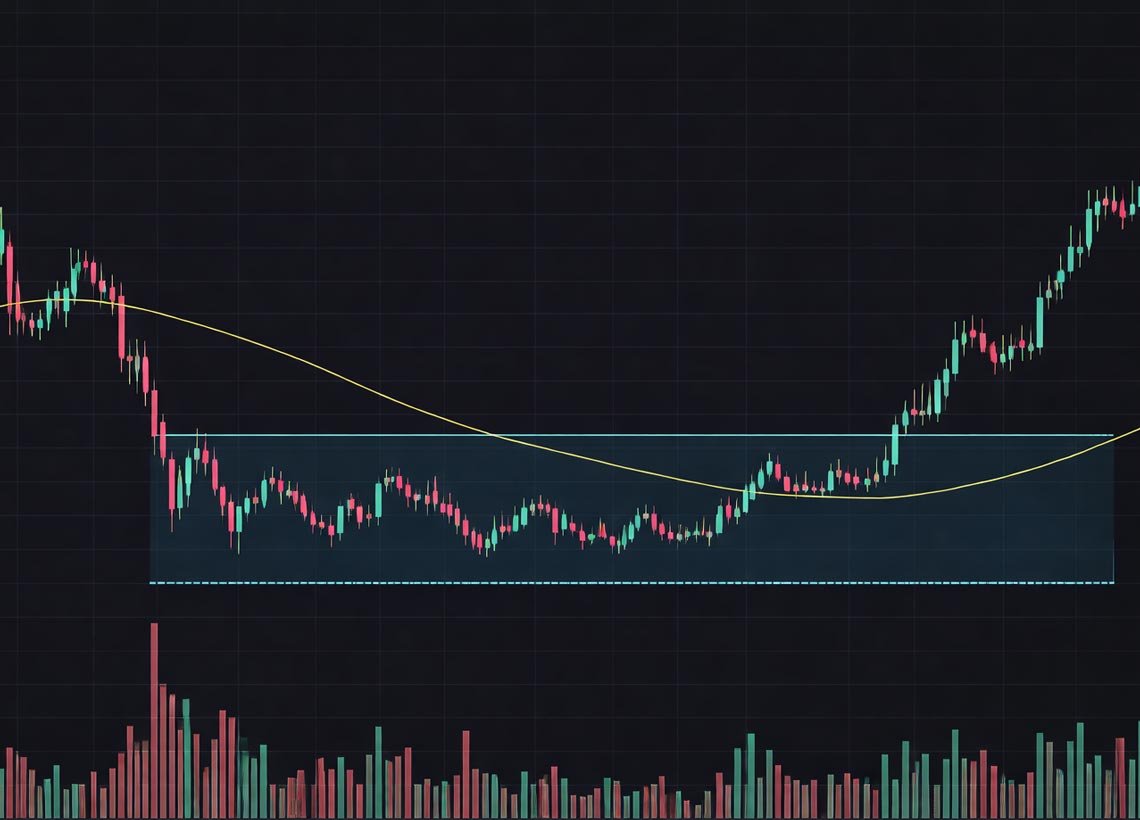
How Accumulation Appears on a Price Chart

How Accumulation Appears on a Price Chart

Accumulation isn’t identified by a single indicator. It’s observed through structure and behavior.

Key visual characteristics include:

  • Sideways price movement after a decline
  • Repeated failed attempts to break lower
  • Gradually rising or stable lows
  • Smaller price swings compared to the previous trend

Volume during accumulation is often low or steady. This reflects the absence of excitement and the intentional discretion of large buyers.

The market may appear “stuck,” but this stability often hides significant positioning beneath the surface.

Accumulation vs Absorption

Accumulation is often confused with absorption, but they are not the same.

Absorption is usually a short-term process that occurs when selling pressure is being neutralized. It often happens immediately after sharp drops and can last from hours to days.

Accumulation, on the other hand, is longer-term and structural. It can include multiple absorption phases as sellers gradually exit and buyers continue building positions. In many cases, absorption is part of accumulation, but accumulation extends beyond it.

Accumulation vs Distribution

Accumulation and distribution can look similar on charts because both involve sideways price action. The difference lies in intent and context.

  • Accumulation occurs after a downtrend, with large players buying.
  • Distribution occurs after an uptrend, with large players selling into strength.

Sideways movement near market lows often signals accumulation. Sideways movement near market highs often signals distribution. Understanding where price is within the broader trend is essential to telling them apart.

How Institutions Use Accumulation

Institutional participants rely heavily on accumulation strategies. They prefer stable prices, low volatility, and reduced attention. By buying gradually:

  • They avoid moving the market against themselves
  • They allow weaker holders to exit
  • They reduce execution risk

Institutions are not concerned with short-term price fluctuations during accumulation. Their focus is on positioning before a larger directional move.

This is why markets often feel uneventful before major rallies begin.

What Happens After Accumulation

Accumulation does not guarantee a price increase. It creates potential energy, not certainty. Once accumulation ends, price may:

  • Break higher if demand expands
  • Remain range-bound if interest stays low
  • Break lower if macro or structural conditions worsen

However, sustained accumulation often precedes the most significant market advances, especially when supported by improving broader conditions.

Why Accumulation Matters

Recognizing accumulation helps traders and investors:

  • Avoid selling near market bottoms
  • Understand low-volatility environments
  • Stay patient during sideways phases
  • Identify early stages of long-term trends

Accumulation isn’t exciting, but it’s foundational. Markets move because positions are built first, not because optimism suddenly appears.

Final Thoughts

Accumulation represents a period of quiet positioning by strong market participants. It occurs after declines, during pessimism, and before meaningful moves. While it doesn’t offer clear signals or immediate rewards, it explains why major trends often begin when the market feels inactive.

Understanding accumulation provides a deeper, more realistic view of how markets truly operate.

Disclaimer: The content provided on this blog is for informational and educational purposes only and does not constitute financial, investment, or legal advice. Cryptocurrency investments involve significant risk, including the potential loss of your entire investment. We are not licensed financial advisors, and any decisions you make based on the information provided are at your own risk.
Previous Post

Strengthen Your Crypto Security. 2FA and Phishing Awareness Matter More Than Ever

Related Posts

What Is Absorption in Crypto Markets and Why It Matters
Crypto-Pedia

What Is Absorption in Crypto Markets and Why It Matters

January 18, 2026
What Is Ethereum And How It Works
Crypto-Pedia

What Is Ethereum And How It Works

December 11, 2025
What Is A Stablecoin - Types Of Stablecoins And How They Work
Crypto-Pedia

What Is A Stablecoin? Types Of Stablecoins And How They Work

December 11, 2025

Premium Content

What Is The Future Of Tether In Europe

What Is The Future Of Tether In Europe?

December 11, 2025
What Is Accumulation in Financial Markets

What Is Accumulation in Financial Markets?

January 24, 2026
The FTX Repayment Plan Restores Trust in the Crypto Market

The FTX Repayment Plan Restores Trust in the Crypto Market

December 11, 2025

Browse by Category

  • Airdrops
  • Bitcoin
  • Crypto-Pedia
  • Market
  • News
  • Safety

Browse by Tags

Airdrop Trump
Crypto Experts

We carefully read, research and filter through the noise to bring you only the most relevant and accurate contentabout the world of crypto.

Categories

  • Airdrops (2)
  • Bitcoin (4)
  • Crypto-Pedia (8)
  • Market (1)
  • News (9)
  • Safety (2)

Recommended

The FTX Repayment Plan Restores Trust in the Crypto Market

The FTX Repayment Plan Restores Trust in the Crypto Market

by George Evan
December 11, 2025
0

...

What Is Absorption in Crypto Markets and Why It Matters

What Is Absorption in Crypto Markets and Why It Matters

by George Evan
January 18, 2026
0

...

Popular Now

What Is Absorption in Crypto Markets and Why It Matters

What Is Absorption in Crypto Markets and Why It Matters

by George Evan
January 18, 2026
0

...

Ethereum Price Stabilizes

Ethereum Price Stabilizes After the $4,900 Drop: What It Means for the Crypto Market

by George Evan
January 18, 2026
0

...

  • About
  • Contact
  • Privacy Policy

© 2025 Crypto Xprts | All rights reserved | Design by Evangelou Print.

No Result
View All Result
  • Bitcoin
  • Market
  • News
  • Airdrops
  • Crypto-Pedia
  • Converter

© 2025 Crypto Xprts | All rights reserved | Design by Evangelou Print.